Transforming Employee Mental Wellness: Conversational AI for Personalized Psychoanalysis
- Admin Godel
- Jul 30, 2025
- 3 min read
Introduction
Mental health concerns are rising globally, yet the ratio of trained professionals to individuals remains alarmingly low. Recent statistics indicate that more than 70% of those needing support do not receive timely care, and many hesitate to seek help due to stigma or fear of judgment. There is a growing need for accessible, judgement-free digital tools that ease individuals into mental wellness journeys. Traditional methods, relying on handwritten notes and rigid protocols, often fail to provide the nuanced support users seek. A personalized, conversational mental wellness product can bridge this gap, empowering people to open up in a non-threatening, dynamic environment.
Client Background
Our client is a wellness startup dedicated to supporting corporate employees with accessible mental health resources. Their core offering provides a confidential support system where employees can freely discuss their concerns, aiming to foster healthier workplaces.
Challenge / Problem Statement
Existing psycho-analytical tools are highly structured and transactional, lacking warmth and personalization.
Users would prefer conversational interactions with dynamic rerouting based on their unique responses.
Repetitive language and rigid session flows increase monotony, discouraging openness.
Psychologists rely on handwritten notes, losing granular data and making outcome tracking difficult.

Objectives
Enable users to interact with a chatbot in natural, supportive language.
Facilitate dynamic, non-repetitive session flows adapting to user input.
Empower users to provide descriptive, context-rich responses.
Streamline psychologist workflows by digitizing session records and branching analyses.
Maintain privacy, reliability, and scalability within corporate environments.
Solution Overview

The heart of the solution is a conversational AI chatbot built with advanced LLMs that can understand and respond to long, nuanced inputs from users. All possible conversation paths are preloaded into memory, allowing for consistent, context-aware interactions that adjust dynamically as users make choices. The chatbot adapts its tone to suit each user, ensuring every session feels unique and approachable.
Key features include:
Natural language comprehension supporting detailed, descriptive user input.
Dynamic conversation rerouting based on user choices.
Rotating language and tonality to avoid session monotony.
Integrated session records replacing handwritten notes for psychologists.
Technical Challenges
Developing this solution presented several unique hurdles:
High LLM Token Costs: Each individual's journey creates a unique conversational context, making caching impossible and causing token usage-and costs-to soar.
Context Window Limitations: LLMs sometimes struggle to process extensive branching paths in a single session, leading to hallucinations if the context window is exceeded.
Personalization at Scale: Every user requires a tailored path, putting pressure on memory management and real-time computation.

Architecture
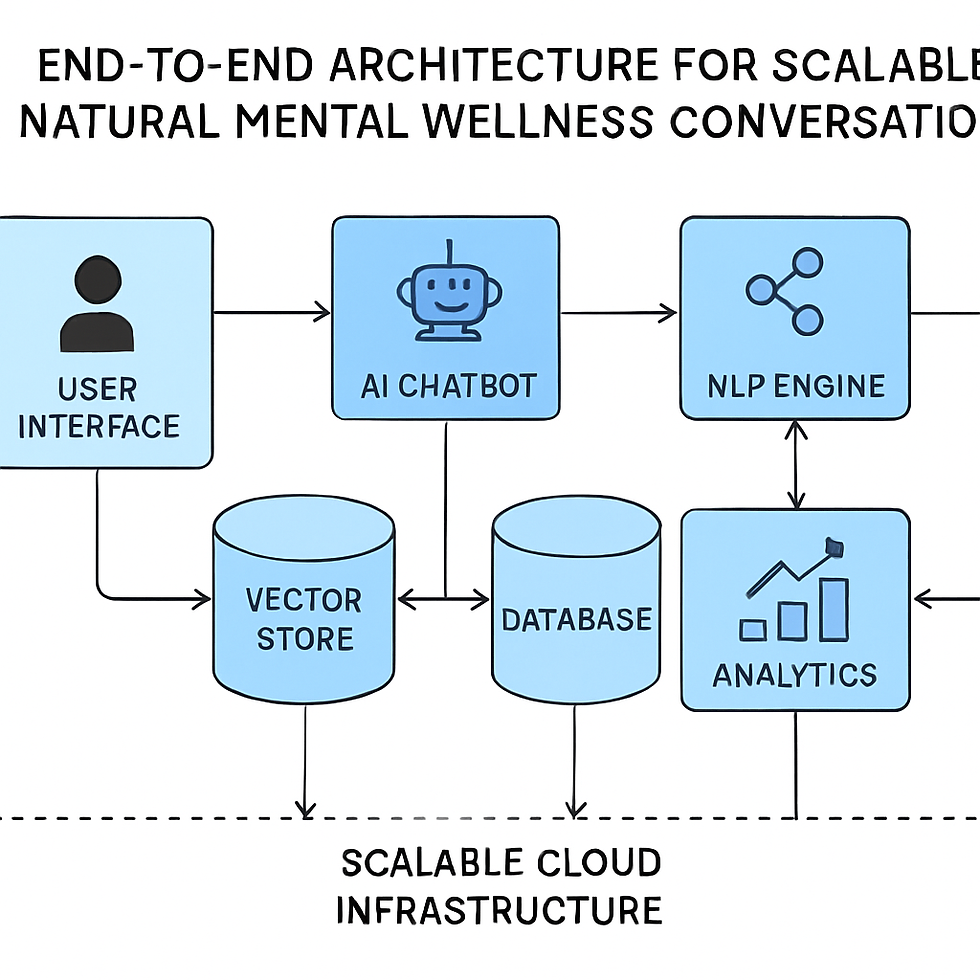
The solution leverages:
Rasa chatbot framework for orchestrating dialogue management.
Custom-coded cyclic unidirectional conversation graphs to model user journeys.
API integrations with LLMs for real-time natural language processing.
AWS Kubernetes clusters for scalable deployment and robust performance in enterprise settings.
Visual Caption: End-to-end architecture powering natural, scalable mental wellness conversations.
Implementation Process
User Journey Modeling:
Workshops with psychologists to map clinical objectives and data requirements.
Designing a cyclic, unidirectional conversation graph for adaptable user flows.
Development:
Encoding conversation graphs within Rasa, ensuring all branches remain accessible.
Integrating LLM APIs and testing for natural, contextually precise responses.
Testing:
Path-by-path validation ensuring user choices map correctly to personalized outcomes.
Adjusting context handling to mitigate hallucination risk.
Deployment:
Rolling out the solution to AWS using Kubernetes, optimized for security and scalability.
Results & Impact
(Note: To be completed post-launch with client-provided data, including user adoption, satisfaction scores, reduction in psychologist workload, unique session flows, and cost-per-session metrics.)
Placeholder for: Data visualizations, before/after screenshots, user testimonials.
Insights
“Natural language is powerful, but balancing cost and user experience remains key.”
Developing a human-like, dynamic chatbot revealed several important insights:
Striking a balance between rich conversational experiences and operational costs is crucial due to LLM tokenization limits.
Real clinical insights from psych professionals were invaluable for building realistic, empathetic flows.
User engagement increases significantly when sessions feel personalized and avoid repetition.

Conclusion & Next Steps

This project highlights the value of blending advanced AI with real-world psychological expertise, delivering dynamic support to employees in need. As we move forward, further optimization around LLM usage, session analytics, and expanding to multilingual support are in the pipeline.
Interested in bringing conversational AI to your wellness solution? Get in touch to explore how we can transform mental health outcomes for your organization.
Comments