Conversational AI for Floor Plan Customisation
- Admin Godel
- Apr 21, 2025
- 4 min read
Updated: Jul 4, 2025

Executive Summary
Architecture firms face persistent challenges in accommodating the countless customisations requested by clients during the floor plan design process. Traditional workflows leave architects fatigued and often lead to premature design freeze, limiting client satisfaction and design potential. We have developed a web-based chatbot solution that empowers clients to make real-time, constraint-aware adjustments to floor plans, dramatically accelerating iterations and reducing the architect’s workload. The result: faster project turnaround, enhanced user engagement, and higher-quality, tailored designs.
Challenge / Problem Statement
Manual customization of floor plans was time-consuming and exhausting for architects, especially as clients requested frequent, iterative changes.
Designers often froze models prematurely to avoid endless revisions, limiting the potential for further customization.
Input drawings were rarely perfect, requiring significant upfront effort to ensure correctness.
Complexity increased with higher-dimensional designs and more product features, making scalability a concern.

Project objectives-streamlining customization through conversational AI
Objectives
Enable rapid, user-driven floor plan customizations via a conversational chatbot interface.
Reduce architects’ workload by shifting basic design edits to the customer.
Ensure all changes respect architectural constraints and maintain design integrity.
Provide a seamless, web-based user experience requiring minimal training.
Lay the groundwork for future expansion to more complex room elements and multi-dimensional design.
Solution Overview
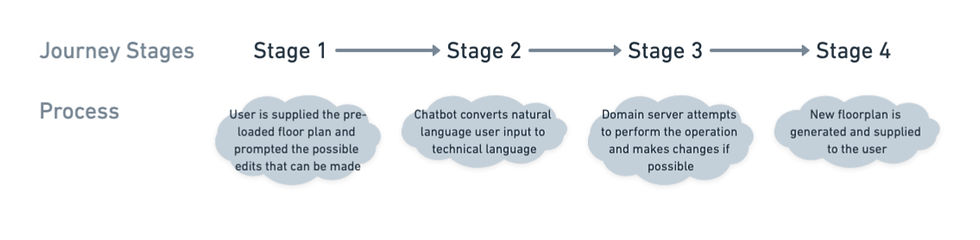
We developed a web-based chatbot interface that allows clients to interact directly with their floor plans. The chatbot connects to a backend model loaded with architectural constraints for each component, ensuring that all changes are valid and feasible.
Key features include:
Conversational interface: Users can request edits in plain language (e.g., “Move the door to the right”).
Constraint validation: The system checks each request against predefined rules (e.g., doors can only slide along walls, minimum clearances).
Visual feedback: Updated floor plan images are generated and sent to the user after each approved change.
Undo functionality: Users can revert changes, promoting experimentation without risk.
Guided assistance: The bot suggests acceptable values and guides users when constraints are not met.
While the sliding door scenario was the initial use case, the architecture is designed to support additional components and more complex configurations in future iterations.


Implementation Process
1. CAD Model Preparation
Apply standardized naming conventions for consistent reference across systems.This ensures seamless data transfer and processing across different modules
Establish a clear layering structure for each object (e.g., walls, doors, furniture).
Preprocess CAD drawings to identify movable objects and define allowable movement ranges (e.g., doors can slide 0–1 along a wall).
2. Chatbot Development
Build a web-based chatbot interface supporting both text and voice input.
Enable the chatbot to stream images from the backend for visual context.
Define and prefill required user inputs for each type of movement to ensure accurate and efficient interaction.
Integrate natural language understanding to interpret user commands (e.g., “slide door left slightly”).
3. Backend Logic & Constraint Engine
Load DXF files into Python using packages like ezdxf.
Implement a constraint engine in Python to validate the feasibility of requested movements.
Programmatically generate and return updated floor plan images based on user interactions.
4. User Interaction Flow
Bot greets user and displays current floor plan.
Guides user through selecting objects to move and specifying new positions.
Provides instant feedback and suggestions if requests exceed constraints.
Allows undo/redo and toggling display layers.
5. Deployment & Testing
Deploy the backend logic and constraint engine as a standalone web application with a publicly accessible API.
Perform functional testing across various combinations of objects and movements to ensure that all constraints are enforced correctly.
Conduct load testing with concurrent users to identify performance bottlenecks and scale the server infrastructure accordingly.
Results & Impact
Iteration speed increase - average design revision cycle reduced from days to minutes.
Client satisfaction improved, with users appreciating direct control over certain design choices.
Error rates in customizations dropped due to automated constraint checking.
Foundation established for expanding to multi-dimensional and multi-object edits.

Challenges & Lessons Learned
Input data quality: Ensuring CAD drawings were properly formatted required upfront investment and clear guidelines for designers.
Scalability: As the scope expands to more objects and dimensions, maintaining intuitive conversational flows and robust constraint logic will be critical.
User training: Minimal training was needed, but clear onboarding and in-app guidance proved essential for adoption.
Key Learning: Automating routine edits frees up architects for higher-value design work, but success depends on robust constraint management and user-centric guidance.
Conclusion & Next Steps
This project demonstrates how conversational AI can revolutionize architectural design workflows-empowering clients, streamlining design iterations, and allowing architects to focus on innovation.
We aim to expand the system to support more room features, complex geometries, and multi-dimensional edits-ultimately enabling fully conversational, constraint-aware floor plan design at scale.
For now, you can explore the project through:
GitHub Repository: https://github.com/Godel-Technologies-LLP/cad-bot.git
Demo Video: archBot.mp4
Comments